As anyone who has been involved in tournament organising knows, scheduling is the worst part of setting everything up. Even once you've worked out the best ways to get all your teams playing on the number of pitches available, without too many back-to-backs, you have referees to sort. The optimum is a head referee, three assistants, a snitch referee, a snitch, two goal referees, a scorekeeper, and a timekeeper - that's ten individuals! You have to make sure that no-one is scheduled more than once (including as players), and that no-one has a conflict of interest; something which has become more difficult to manage now everyone seems to have played for two or even three teams across the seasons. Throughout the season there have been several approaches, finishing with the best organised event I was a part of, World Cup. Here I will discuss what I feel are the best approaches in an ideal world, and how I currently would deal with the compromises necessary.
Starting with World Cup, this year's event ran incredibly smoothly. Even with 45 minute gameslots, which have sounded death knells for European tournaments recently, games started promptly and with full teams. Part of the reason I feel it was so successful was the introduction of standby referee teams - a full team of qualified referees ready to slot in on any of the four pitches if someone was late. Though they had the advantage of having almost exclusively non-playing referees available, I still didn't expect everything to go as punctually and I was more than pleasantly surprised. If every tournament had a set of referees who knew they should make themselves available to the tournament committee at a specific location before every match slot, finding replacements would go far swifter. For the past two BQCs I did create lists of free referees, but they were scattered across the tournament location and thus it was not as effective as what happened at World Cup. I filled one standby slot at World Cup, on the first day, and after not being needed could get on with spectating for that slot - it was hardly an inconvenience.
Going forward in international country-level competitions, I feel that quidditch could learn from other sports. Often, countries assemble full referee teams which then stay together for an entire tournament, and are then available as a unit for the schedulers. This could work for the next World Cup or even European Games - the UK, for example, should easily be able to provide two full referee teams, perhaps both with two snitches. The best referees are likely to all be head referee qualified, so the team could rotate who filled that role. Smaller, less developed countries could team up to provide a unit. This could be used in conjunction with the previous idea of standby referee teams (though I feel standbys should be used more widely than international competition), by replacing whole teams if a component is missing. Having set teams of referees could also be an advantage to players as well, who are more likely to know what to expect from referee teams later in a competition if they have been under them before, rather than having variables that effect the overall quality of the refereeing.
But back to domestic, club competitions where it isn't practical to require clubs to provide full teams. I have scheduled the referees for the last two BQCs, and I worked on a few parameters. Generally speaking, referees would not be involved in games that were affecting their group (if they were players). In an ideal world, this would extend to clubs - though that becomes a little restrictive and is the first of the rules to waive. Secondly, close games are identified and at least two strong referees are assigned to those. Again ideally all games would be refereed with equal quality, but we do not have enough referees in this country certainly to achieve that parity, so the anticipated 'hardest' matches are given the best referees. Care should be taken, however, to not leave a full team of inexperienced referees without someone more confident to guide them if necessary. The difference between the best and worst referee teams during group stages should be minimal. Finally, referees should have an appropriate number of breaks. Some referees like being on their feet all day - I'm one of them - whereas others, particularly those competing for the top teams, prefer not to run themselves ragged. Obviously this is only possible if you have enough referees!
I have a database set up which I use for my scheduling (nicknamed 'Fordsheed') and has been very helpful in sorting everything out relatively quickly. It works by giving every referee an entry, which then links to their team, and what positions they are willing to fill. The team schedule is then created, which links team availability to their timeslot. Then, for each timeslot, I can search for the available referees of each position and use that to fill up the schedule with confidence that no-one is in two places at once. Just to check, I have an error sheet which shows up anyone who has been assigned twice. The long list of numbers then generates the schedule, and can also be used to create individual schedules and lists of free individuals. Generally I will work methodically by position, starting with head referees and snitches, then matching snitch referees to the snitches, and trying to find complimentary assistant referees to finish the qualified team. I've also used it to assign goal referees, scorekeepers, and timekeepers, as well as other tournament volunteers. Unfortunately it isn't terribly user-friendly as a system, or I would've lent it out to people!
Scheduling for the first day is one thing, scheduling for knockout play is another thing completely. You can't predict it, you don't know which teams and therefore which conflicts of interest are going to be present at each round, and you might even have two brackets to deal with simultaneously. It isn't fun. This is where the referee team system has an advantage, because if Australia are playing Spain at the World Cup then all you need to do is pick a referee team that isn't from Australia or Spain. There's no need to individually pick up to 10 people from a potentially huge list. At this year's World Cup, every round was preceded by a referee meeting where the officials were picked, and this worked well - but mainly, I feel, because referees were not distracted by being with their teams as they might be in a domestic tournament. It could probably be effective in a fantasy tournament though, where there is not so much of a team bond. So generally I'd advise having one or two individuals on the tournament committee who aren't playing, and can be solely dedicated to sorting out referee schedules for each round as they come. This requires a bit more time, and still means the referees need to gather to have this communicated to them, but they don't have to be there for as long. It probably does necessitate a longer gameslot though, to have time to accrue the results and then sort who is refereeing.
Then, of course, there are the finals. Who do you pick? How do you tell them? Generally from the quarter finals onwards, the pool of referees is restricted to the best. This pool should be made of those who have been consistent, both across the season and across the tournament - stand-out new referees should always be considered if they have shone out to other referees and to teams. Checking with captains is a good way to eliminate referees who have disappointed across multiple games, and also checking with the top referees who may have worked with multiple groups across the weekend. But the most important thing to check with, particularly for finals, is the referees themselves. Some may not be comfortable with stepping into the role for a final, or maybe they want to just spectate the match. If you don't give them a chance to reject, and they feel forced into it, it could seriously affect their ability to perform and the likelihood of them refereeing again. Ultimately, they are still volunteers, and should be excited and happy about the prospect of being involved. This means asking them individually, and not shaming them if they say no - and maybe offering them a lower position in the referee team if available. This should go for everyone on pitch, right down to the goal referees (following the tradition now that everyone on the pitch is head referee qualified, some may not be as pleased as I was to stand behind the hoops for a game). Respect is key!
I could go into much more detail on everything here, but to summarise: standby referee teams are a great thing I feel we should try and introduce; country-based referee teams could work wonderfully for European Games and World Cup; referees should be chosen to minimise conflict of interest and maximise parity across all games; technology is good at helping if you check it for 40 hours; assigning referees in bracket play requires dedicated volunteers; referees for finals should be chosen for their performance consistency and requested respectfully. Oh, and we could all do with more non-playing referees, always.
Thursday, 18 August 2016

Thursday, 11 August 2016
Signals
Why are signals important? To many, referees included, they are just a funny appendix at the back of the USQ rulebooks, and for some reason this has made them optional. Really though, they shouldn't be. There's a lot to be gained by knowing the signals, both as a referee and as a player. Everyone knows goal and no goal, sure, but how many of you could demonstrate the signal for illegal procedure? Over the past season I have been trying to increase my use of signals, but that isn't really helpful to anyone if they don't know what I'm saying with my hands. This article has been made with the help of the wonderful referees at World Cup, who posed for me on one of the few breaks we had to get all of these covered in a more colourful way than the rulebook. My thanks also go to Chris LeCompte who demonstrated nearly all of them (plus an invented one) about two feet higher than everyone else during the weekend and showed just how much can be said without using words.
Signals everyone should know:

This signals: Good Goal
Accompanying whistle blast: Single long blast
Why players should know it: Until the whistle blows to signify the goal, along with the arm signal, the quaffle is still live. You may be able to score - or stop - a goal if you continue right until the whistle.
Why volunteers should know it: Obviously referees on the pitch will be using the signal every time a goal is scored. Scorekeepers should know it for confirmation of a good goal, and then they can accurately update the score. Keep an eye out for overrules afterwards, however!
This signals: No Goal/Bad Snitch Catch
Accompanying whistle blast: none
Why players should know it: A no goal signal could give you the chance to continue playing and finish off the offensive or defensive play. It could also make you aware that the goal wasn't good if there is an overruling due to a foul or otherwise, so you can keep track of the score if you need to know for snitch play.
Why volunteers should know it: Scorekeepers should keep an eye out for this one in particular if it comes after a stoppage of play to then cancel a previously given goal.

This signals: Keeper's ball
Accompanying whistle blast: none
Why players should know it: When the head referee is showing this signal, the keeper holding the ball has immunity from tackles and beats while they are in their defensive keeper zone. It is also illegal to tackle a keeper with this immunity and you could end up with a card! A referee properly utilising this signal will also then show you when the keeper loses the immunity, meaning you can proceed to tackle them if you wish.
Why volunteers should know it: It's one of the easiest signals to get in the habit of using, and when you do it correctly, it can really help when deciding if a keeper has been illegally challenged.
 (x3)
This signals: Good snitch catch/End of a period of play
Accompanying whistle blast: Three long blasts
Why players should know it: Obviously it signals when you've won if you were out of SWIM when the snitch was caught, but it also signals the end of five minutes in first overtime if there is no snitch catch, and if the score (catch or goal) was good in second overtime.
Why volunteers should know it: Timekeepers, time to stop the clock and write down the time. Scorekeepers, you need to work out the final score and sort out the scoresheet.
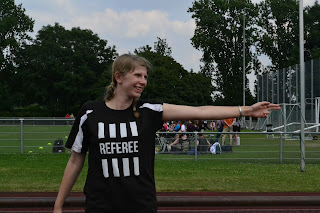
This signals: Knocked out/Dismount/Back to hoops
Accompanying whistle blast: none
Why players should know it: Ignorance is not an excuse for breaking the rules, so listen and watch for back to hoop calls and don't argue.
Why volunteers should know it: Pointing to the hoops of the player in question will reduce confusion if someone is also called safe from friendly fire.

This signals: Stop play
Accompanying whistle blast: Pairs of whistle blasts, until everyone stops
Why players should know it: If you hear the double whistle on your pitch, your instinct should be to stop play straight away, and drop your broom where you were when the whistle went. There's no point playing over the whistle - but equally don't stop play unless you hear the double blasts.
Why volunteers should know it: Timekeepers need to remember to pause the timer immediately when the double blasts start.

This signals: Resume play
Accompanying whistle blast: Single short whistle blast
Why players should know it: Even if you might not hear the whistle, you can look for this hand signal to know just when you can start up again.
Why volunteers should know it: Timekeepers will resume the timer when the whistle and signal come.

This signals: Delayed penalty
Accompanying whistle blast: none
Why players should know it: Generally speaking, head referees ask for their assistant referees to point at the bench of the team who fouled, which is also the direction that play should continue in if advantage is then being used. So if you're the team who has been fouled, and you want to know why the referee hasn't called it straight away, this might be why!
Why volunteers should know it: This just really helps head referees keep games flowing smoothly, so if assistant referees get used to it then life will be much easier for everyone.

This signals: Advantage
Accompanying whistle blast: none
Why players should know it: If the head referee is calling advantage, they have seen a foul and are letting play go on. The quaffle player who was fouled will be returned to the point where the foul occurred, but the other players will stay where they were when advantage abated and play was stopped. So if you are fouled and then play continues, this is probably why.
Why volunteers should know it: In overtime, the stopwatch should be paused as soon as the head referee raises their fist to call advantage, so timekeepers should be aware.

This signals: Warning
Accompanying whistle blast: none
Why players should know it: Official warnings will be a lot easier to identify when accompanied by this hand signal, so you know when to tone it down with whatever you were doing.
Why volunteers should know it: Often there is no distinction between an official warning and a friendly reminder/note - this will help that.

This signals: Blue/Yellow/Red Card + Penalty time
Accompanying whistle blast: none
Why players should know it: It's always good to know what penalty you got, and how much time you're spending in the box.
Why volunteers should know it: Scorekeepers should remind head referees if they are giving a player a second yellow card, which would lead to a red card.
Signals captains, coaches, referees, and volunteers should know:
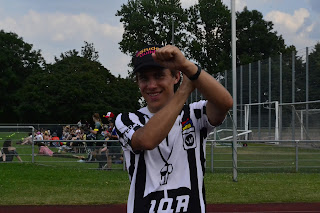
This signals: General illegal contact
Description: Both hands in fists, crossing above the head repeatedly.
Why coaches/captains should know it: If you haven't approached the referee when the decision was made and called, and you are unable to hear the call, seeing this signal will indicate what type of foul has been committed. Then you can work out if you think it is fair or not rather than making a fuss because you don't know the foul.
Why volunteers should know it: Scorekeepers should write down what foul has been committed, and sometimes players are less than helpful in passing on what exactly they did.

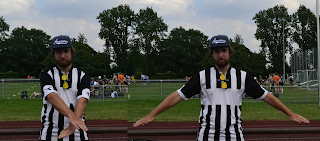
This signals: Illegal procedure
Description: As shown, with the arms rolling.
Why coaches/captains should know it: If you are called for an illegal procedure, it's time to start tightening up on your substitutions and other gameplay elements of the match.
Why volunteers should know it: Scorekeepers should write down what foul has been committed, and sometimes players are less than helpful in passing on what exactly they did.

This signals: Delay of game
Description: Two fingers tapping the wrist, as if there was a watch there.
Why coaches/captains should know it: If this is being called and you see this signal, you can relay to the team that the quaffle needs to be advanced faster - sometimes referees call delay differently, but there aren't any excuses for being penalised twice.
Why volunteers should know it: Scorekeepers should write down what foul has been committed, and sometimes players are less than helpful in passing on what exactly they did.

This signals: Illegal contact to X (neck)
Description: Open hand, chopping motion towards the body part which was contacted on the fouled player.
Why coaches/captains should know it: This will show where the illegal contact was made, though note that if multiple illegal contacts were made in one play then the referee may only show one.
Why volunteers should know it: Specific area where the contact was made can then be written on the scorecard without delaying the game by having to ask the referee.

This signals: Illegal contact with X (leg)
Description: Pointing to the location on the body which the fouling player used to contact the opposing player.
Why coaches/captains should know it: Shows which area of the body was used illegally, which may not be clear from a different angle, to explain why the foul was given.
Why volunteers should know it: Specific area where the contact was made can then be written on the scorecard without delaying the game by having to ask the referee.

This signals: Illegal interaction
Description: Hands in fists, arms making a T.
Why coaches/captains should know it: Shows that an illegal pick, interaction between bludger and quaffle play, or other illegal interaction has happened, which could be something very technical you hadn't seen.
Why volunteers should know it: Scorekeepers should write down what foul has been committed, and sometimes players are less than helpful in passing on what exactly they did.

This signals: Unsportsmanlike conduct
Description: Hands on hips.
Why coaches/captains should know it: If this comes out, someone on your team has messed up and probably needs some serious discipline. Likely causes are foul or disrespectful language towards players, officials, or spectators, and throwing equipment dangerously. Basically, breaking the first rule of quidditch.
Why volunteers should know it: Scorekeepers should write down what foul has been committed, and sometimes players are less than helpful in passing on what exactly they did.
With all of the more specific signals, these can be helpful in showing exactly what foul has been committed, and thus what to look out for and improve on in training.
I hope you have learnt something. At some point in the future I'd like to film and make gifs of some of the more complicated ones, but that requires time, equipment, and skills I don't have access to at the moment! I might do it with my NGB, QuidditchUK, and if it comes out through them I will of course share it here too.
All photos were taken by Nicole Stone, with the exception of the ones of me in my garden, which were taken by my sister.
Signals everyone should know:

This signals: Good Goal
Accompanying whistle blast: Single long blast
Why players should know it: Until the whistle blows to signify the goal, along with the arm signal, the quaffle is still live. You may be able to score - or stop - a goal if you continue right until the whistle.
Why volunteers should know it: Obviously referees on the pitch will be using the signal every time a goal is scored. Scorekeepers should know it for confirmation of a good goal, and then they can accurately update the score. Keep an eye out for overrules afterwards, however!

This signals: No Goal/Bad Snitch Catch
Accompanying whistle blast: none
Why players should know it: A no goal signal could give you the chance to continue playing and finish off the offensive or defensive play. It could also make you aware that the goal wasn't good if there is an overruling due to a foul or otherwise, so you can keep track of the score if you need to know for snitch play.
Why volunteers should know it: Scorekeepers should keep an eye out for this one in particular if it comes after a stoppage of play to then cancel a previously given goal.

This signals: Keeper's ball
Accompanying whistle blast: none
Why players should know it: When the head referee is showing this signal, the keeper holding the ball has immunity from tackles and beats while they are in their defensive keeper zone. It is also illegal to tackle a keeper with this immunity and you could end up with a card! A referee properly utilising this signal will also then show you when the keeper loses the immunity, meaning you can proceed to tackle them if you wish.
Why volunteers should know it: It's one of the easiest signals to get in the habit of using, and when you do it correctly, it can really help when deciding if a keeper has been illegally challenged.
 (x3)
This signals: Good snitch catch/End of a period of play
Accompanying whistle blast: Three long blasts
Why players should know it: Obviously it signals when you've won if you were out of SWIM when the snitch was caught, but it also signals the end of five minutes in first overtime if there is no snitch catch, and if the score (catch or goal) was good in second overtime.
Why volunteers should know it: Timekeepers, time to stop the clock and write down the time. Scorekeepers, you need to work out the final score and sort out the scoresheet.

This signals: Knocked out/Dismount/Back to hoops
Accompanying whistle blast: none
Why players should know it: Ignorance is not an excuse for breaking the rules, so listen and watch for back to hoop calls and don't argue.
Why volunteers should know it: Pointing to the hoops of the player in question will reduce confusion if someone is also called safe from friendly fire.

This signals: Stop play
Accompanying whistle blast: Pairs of whistle blasts, until everyone stops
Why players should know it: If you hear the double whistle on your pitch, your instinct should be to stop play straight away, and drop your broom where you were when the whistle went. There's no point playing over the whistle - but equally don't stop play unless you hear the double blasts.
Why volunteers should know it: Timekeepers need to remember to pause the timer immediately when the double blasts start.

This signals: Resume play
Accompanying whistle blast: Single short whistle blast
Why players should know it: Even if you might not hear the whistle, you can look for this hand signal to know just when you can start up again.
Why volunteers should know it: Timekeepers will resume the timer when the whistle and signal come.

This signals: Delayed penalty
Accompanying whistle blast: none
Why players should know it: Generally speaking, head referees ask for their assistant referees to point at the bench of the team who fouled, which is also the direction that play should continue in if advantage is then being used. So if you're the team who has been fouled, and you want to know why the referee hasn't called it straight away, this might be why!
Why volunteers should know it: This just really helps head referees keep games flowing smoothly, so if assistant referees get used to it then life will be much easier for everyone.

This signals: Advantage
Accompanying whistle blast: none
Why players should know it: If the head referee is calling advantage, they have seen a foul and are letting play go on. The quaffle player who was fouled will be returned to the point where the foul occurred, but the other players will stay where they were when advantage abated and play was stopped. So if you are fouled and then play continues, this is probably why.
Why volunteers should know it: In overtime, the stopwatch should be paused as soon as the head referee raises their fist to call advantage, so timekeepers should be aware.

This signals: Warning
Accompanying whistle blast: none
Why players should know it: Official warnings will be a lot easier to identify when accompanied by this hand signal, so you know when to tone it down with whatever you were doing.
Why volunteers should know it: Often there is no distinction between an official warning and a friendly reminder/note - this will help that.

This signals: Blue/Yellow/Red Card + Penalty time
Accompanying whistle blast: none
Why players should know it: It's always good to know what penalty you got, and how much time you're spending in the box.
Why volunteers should know it: Scorekeepers should remind head referees if they are giving a player a second yellow card, which would lead to a red card.
Signals captains, coaches, referees, and volunteers should know:

This signals: General illegal contact
Description: Both hands in fists, crossing above the head repeatedly.
Why coaches/captains should know it: If you haven't approached the referee when the decision was made and called, and you are unable to hear the call, seeing this signal will indicate what type of foul has been committed. Then you can work out if you think it is fair or not rather than making a fuss because you don't know the foul.
Why volunteers should know it: Scorekeepers should write down what foul has been committed, and sometimes players are less than helpful in passing on what exactly they did.

This signals: Illegal procedure
Description: As shown, with the arms rolling.
Why coaches/captains should know it: If you are called for an illegal procedure, it's time to start tightening up on your substitutions and other gameplay elements of the match.
Why volunteers should know it: Scorekeepers should write down what foul has been committed, and sometimes players are less than helpful in passing on what exactly they did.

This signals: Delay of game
Description: Two fingers tapping the wrist, as if there was a watch there.
Why coaches/captains should know it: If this is being called and you see this signal, you can relay to the team that the quaffle needs to be advanced faster - sometimes referees call delay differently, but there aren't any excuses for being penalised twice.
Why volunteers should know it: Scorekeepers should write down what foul has been committed, and sometimes players are less than helpful in passing on what exactly they did.

This signals: Illegal contact to X (neck)
Description: Open hand, chopping motion towards the body part which was contacted on the fouled player.
Why coaches/captains should know it: This will show where the illegal contact was made, though note that if multiple illegal contacts were made in one play then the referee may only show one.
Why volunteers should know it: Specific area where the contact was made can then be written on the scorecard without delaying the game by having to ask the referee.

This signals: Illegal contact with X (leg)
Description: Pointing to the location on the body which the fouling player used to contact the opposing player.
Why coaches/captains should know it: Shows which area of the body was used illegally, which may not be clear from a different angle, to explain why the foul was given.
Why volunteers should know it: Specific area where the contact was made can then be written on the scorecard without delaying the game by having to ask the referee.

This signals: Illegal interaction
Description: Hands in fists, arms making a T.
Why coaches/captains should know it: Shows that an illegal pick, interaction between bludger and quaffle play, or other illegal interaction has happened, which could be something very technical you hadn't seen.
Why volunteers should know it: Scorekeepers should write down what foul has been committed, and sometimes players are less than helpful in passing on what exactly they did.

This signals: Unsportsmanlike conduct
Description: Hands on hips.
Why coaches/captains should know it: If this comes out, someone on your team has messed up and probably needs some serious discipline. Likely causes are foul or disrespectful language towards players, officials, or spectators, and throwing equipment dangerously. Basically, breaking the first rule of quidditch.
Why volunteers should know it: Scorekeepers should write down what foul has been committed, and sometimes players are less than helpful in passing on what exactly they did.
With all of the more specific signals, these can be helpful in showing exactly what foul has been committed, and thus what to look out for and improve on in training.
I hope you have learnt something. At some point in the future I'd like to film and make gifs of some of the more complicated ones, but that requires time, equipment, and skills I don't have access to at the moment! I might do it with my NGB, QuidditchUK, and if it comes out through them I will of course share it here too.
All photos were taken by Nicole Stone, with the exception of the ones of me in my garden, which were taken by my sister.
Thursday, 4 August 2016
The referee/friend dynamic
Everyone in the quidditch community knows everyone else.
This may not be as true now as it was two years ago, but broadly speaking we know most people in the UK scene, and I'm going to argue that in some ways, it is harming our referees' ability to grow and improve, and also to do their jobs. Going to World Cup only made the issues clearer to me, going from refereeing teams I know well to refereeing teams and players I've barely heard of, if at all.
As a head referee, I am one of a small percentage of the UK quidditch community who is paid to be on the pitch. It is a job, and even when I am assistant refereeing or otherwise I consider it so. This is different to most teams (with a probable exception of Team UK), where they want to do well, but there is no external expectation on them to perform at their highest level and the one thing pushing them on is internal pride, not a sense of owing the community anything. But whilst Team UK are boosted by the words of the community, which are >99% positive as far as I have seen, the referees do not get that luxury.
Like a lot of people, I have friends on many different quidditch teams. I've drunk absinthe with Keele, I've been to many pubs with Loughborough, I've learnt about the secret Falmouth scout hut rituals. But on the pitch, I'm not supposed to be your friend. I'm an official, I'm impartial, I am there to make sure a good game of quidditch happens for all parties. However, this is hard when automatically, your brain wants to chat away to your friends and maybe only give them a slap on the wrist when they should be sent to the naughty step. Fixing this attitude will take work from both players and referees. This is one of the minor issues caused by the closeness of the community, but a far bigger problem is when this turns into bias, even unconscious, for or against the teams and players on pitch.
As a referee, you are supposed to go into every game with no preconceptions about the players or teams you are about to officiate. This is to make sure you don't base calls on assumptions, such as being more harsh on a player from a team known for playing dirty, or let someone off lightly because 'well usually they're okay'. However, this is impossible in quidditch in the UK right now. Even if you haven't met a team or seen a player, word can travel quickly - usually through facebook. Most people could name at least five players they would instinctively watch for contact from, and as a referee this is bad. It's unfair on the players in question - everyone on pitch should be treated equally and no assumptions should be made about who might be making illegal plays. There's also another effect: some referees may overcompensate for the fact that they are friends with certain people, and thus treat them more harshly because they don't want to look like they are playing favourites. This also isn't fair on those players, who wouldn't receive such a harsh penalty from a different referee who wasn't trying to prove a point.
If I'm going to referee say, Liverpuddly Cannons vs Manchester Manticores, it might be easier because I don't know much about either team. I can go in with no idea who's going to win, who's going to score the hoops, and who is going to make me get my cards out. But as soon as I'm refereeing well-established teams it's an entirely different matter. And it's not only the fact that I know who they are - they also know me. I should clarify here that by well-established I'm assuming that I know a core of the team pretty well; Team USA is better established than the majority of UK teams but I certainly don't know any of them well enough to consider myself at risk of being biased due to knowing them socially. But in the UK, if you've been around a season, I probably know who you are and what you're going to be like on pitch. To answer the question I posed at the beginning of the paragraph, I'm not sure. I have a few ideas that I'll pitch later, but there isn't a good solid answer.
When I referee, I know I try to remain personable. Part of this is a defense against being seen as overly bossy or angry - see my article on sexism in refereeing for more details on that. However, I have to make sure that even when I'm doing this, I do not change the call I make for a foul based on who committed it. I have given cards to friends before, mostly without worrying about any potential repercussions. The issues come when I am carding acquaintances, and I'm sure many referees will feel the same way - there is a worrying voice in the back of my head that this person will carry this call off the pitch and let that affect how they see me as a person. Many people you see at tournaments you later end up seeing at the social, and at the next tournament, and whilst the vast majority will never judge you as a person for what you call them for as a referee, the concern is always there (for me at least). It's one of the reasons I feel red cards aren't given enough - a referee might be lenient on a call which would otherwise be a yellow card, because a second for that player would have them sent off and they don't want to do that. Fouls should be judged independently to what has occurred earlier, just as the punishments shouldn't be influenced by who is involved.

This may not be as true now as it was two years ago, but broadly speaking we know most people in the UK scene, and I'm going to argue that in some ways, it is harming our referees' ability to grow and improve, and also to do their jobs. Going to World Cup only made the issues clearer to me, going from refereeing teams I know well to refereeing teams and players I've barely heard of, if at all.
There have (rightly) been many comments floating around that a lot of referees in quidditch do not accept criticism, even constructive. This is a big topic and one for continuing another week, but I think the dissonance with how referees are perceived and how they feel they are perceived is important and I will discuss that part here. In general, accepting criticism can be hard - it is certainly something I have struggled with personally in the past, aside from on the quidditch pitch. From my experience of confronting this issue, I think that the main reason the refereeing community ignores criticism is to protect themselves. It can be a defense mechanism, in situations where differentiating between destructive and constructive criticism can be stressful. For referees, this could translate to finding it easier to just ignore everything coming from your peers rather than dealing with reading and overcoming destructive criticism whilst trying to identify what you can actually use and learn from. I do not think this is the most helpful path, however I can understand why many do it.
Kevin Oelze accurately describes an aspect of this in his Eighth Man article - 'if you referee them, you get the amazing side benefit of publicly watching your friends and anyone with an opinion absolutely ripping into your refereeing for which you got paid (maybe) minimum wage'. I definitely agree with Oelze's quote. It's very hard as a person to see my peers slam my performance in black and white in a way they'd rarely do when I'm playing for my team. Sure, you might tell someone they were off their game, but that's nowhere near the complete trashing some referees are given - directly, anonymously, or otherwise - after some games. The ratio of constructive to destructive criticism given to referees can often feel heavily skewed towards destructive, especially on social media and when referees are discussed as a whole. The negative attitude is discouraging in itself, but this is exacerbated when it is coming from people you consider to be friends. As someone with an anxiety disorder, I may be more prone to assuming the worst and assuming that everyone thinks I'm terrible, but I can't imagine that it's easy for anyone to ignore that niggling voice in your head which tells you to just give up on this thing you are clearly bad at. (For clarification, I don't actually think I'm a bad referee. I have a pretty decent sized refereeing ego. But still a person worries from time to time.) Referees have a far lower return rate from season to season compared to players, and whilst I'm sure it just really isn't for some people, I'd be willing to bet that decent referees have been 'forced' out of that aspect of quidditch due to the general attitude of players towards them. New referees especially feel they should quit rather than work to improve.
All of this leads to the first point I made at the beginning - hindering the ability of referees to improve. Everyone starts of as an unspectacular referee, with many flaws and areas in need of (sometimes vast) improvement. The top referees in the country still have work to do, as the rulebook changes and as teams evolve the way the game is played. Improvement comes from feedback, with honest and respectful criticisms, so you can analyse the weak points and pay attention to them in later games. But if most of what you hear about refereeing is negative and destructive, it can be wearying to find the small amounts of helpful information, and you may not even bother trying after a while. The refereeing community as a whole has taken this attitude, and although there are individuals who work hard and take feedback well, the culture is not of improvement as a response to criticism. I feel that this is because there is a loud player-base that feels very strongly about how games should be refereed (usually more or less like a mainstream sport of their choice), who usually speak with no experience of refereeing quidditch. A lot of the time their defense is that fans of said other sport speak similarly about referees there - but how many Premier League referees read the Facebook discussions of fans, or even hear the locker room discussions of players? This is the key difference: referees are almost always players, almost always your direct peers, and will therefore have a different reaction to your words.
As a head referee, I am one of a small percentage of the UK quidditch community who is paid to be on the pitch. It is a job, and even when I am assistant refereeing or otherwise I consider it so. This is different to most teams (with a probable exception of Team UK), where they want to do well, but there is no external expectation on them to perform at their highest level and the one thing pushing them on is internal pride, not a sense of owing the community anything. But whilst Team UK are boosted by the words of the community, which are >99% positive as far as I have seen, the referees do not get that luxury.
Like a lot of people, I have friends on many different quidditch teams. I've drunk absinthe with Keele, I've been to many pubs with Loughborough, I've learnt about the secret Falmouth scout hut rituals. But on the pitch, I'm not supposed to be your friend. I'm an official, I'm impartial, I am there to make sure a good game of quidditch happens for all parties. However, this is hard when automatically, your brain wants to chat away to your friends and maybe only give them a slap on the wrist when they should be sent to the naughty step. Fixing this attitude will take work from both players and referees. This is one of the minor issues caused by the closeness of the community, but a far bigger problem is when this turns into bias, even unconscious, for or against the teams and players on pitch.
As a referee, you are supposed to go into every game with no preconceptions about the players or teams you are about to officiate. This is to make sure you don't base calls on assumptions, such as being more harsh on a player from a team known for playing dirty, or let someone off lightly because 'well usually they're okay'. However, this is impossible in quidditch in the UK right now. Even if you haven't met a team or seen a player, word can travel quickly - usually through facebook. Most people could name at least five players they would instinctively watch for contact from, and as a referee this is bad. It's unfair on the players in question - everyone on pitch should be treated equally and no assumptions should be made about who might be making illegal plays. There's also another effect: some referees may overcompensate for the fact that they are friends with certain people, and thus treat them more harshly because they don't want to look like they are playing favourites. This also isn't fair on those players, who wouldn't receive such a harsh penalty from a different referee who wasn't trying to prove a point.
If I'm going to referee say, Liverpuddly Cannons vs Manchester Manticores, it might be easier because I don't know much about either team. I can go in with no idea who's going to win, who's going to score the hoops, and who is going to make me get my cards out. But as soon as I'm refereeing well-established teams it's an entirely different matter. And it's not only the fact that I know who they are - they also know me. I should clarify here that by well-established I'm assuming that I know a core of the team pretty well; Team USA is better established than the majority of UK teams but I certainly don't know any of them well enough to consider myself at risk of being biased due to knowing them socially. But in the UK, if you've been around a season, I probably know who you are and what you're going to be like on pitch. To answer the question I posed at the beginning of the paragraph, I'm not sure. I have a few ideas that I'll pitch later, but there isn't a good solid answer.
When I referee, I know I try to remain personable. Part of this is a defense against being seen as overly bossy or angry - see my article on sexism in refereeing for more details on that. However, I have to make sure that even when I'm doing this, I do not change the call I make for a foul based on who committed it. I have given cards to friends before, mostly without worrying about any potential repercussions. The issues come when I am carding acquaintances, and I'm sure many referees will feel the same way - there is a worrying voice in the back of my head that this person will carry this call off the pitch and let that affect how they see me as a person. Many people you see at tournaments you later end up seeing at the social, and at the next tournament, and whilst the vast majority will never judge you as a person for what you call them for as a referee, the concern is always there (for me at least). It's one of the reasons I feel red cards aren't given enough - a referee might be lenient on a call which would otherwise be a yellow card, because a second for that player would have them sent off and they don't want to do that. Fouls should be judged independently to what has occurred earlier, just as the punishments shouldn't be influenced by who is involved.

Good friends are like donuts - sweet! Ajantha Abey
So what can we do about all this?
At World Cup, I found it a lot easier to brush off destructive comments from players than I would have done at BQC, and it wasn't just because I've improved in the past few months. This was most likely because I didn't know the players, and even the European players I'd met a few times were easier to deal with mentally than any UK players. So this suggests to me that being removed socially from the players you are refereeing makes it easier, because the nasty comments can be brushed away as they aren't tied to a social opinion of the person, and constructive advice (often delivered more positively) is a lot easier to identify and take on board. The UK community is growing at an incredible rate, and it's highly likely that if I go to Northern Cup next season there will be a good percentage of teams and players I've never met before. So maybe the problem will resolve itself to some extent as we move away from a community where you can put a name and a play style to every face you see.
As for changing the way referees respond to criticism, that is far less up to the general community. I have definitely been guilty of telling referees to ignore what has been said and give bland compliments in the past, but this season I have been working on instead giving the feedback I would like to hear as a referee. It's very rare still for a friend to comment on your refereeing if they just watched the game of quidditch, but especially at World Cup I tried to pay a lot of attention to the referees so I could work out where either they or I could improve in the future. I also asked for feedback from the head referees I was under, and I think this is maybe the easiest thing to introduce across the board to get referees used to hearing criticism and also knowing it is coming from an experienced and fair source. No two referees are the same, and all of us can learn from the others - next season I will try my hardest to both ask and give constructive points to my referee teams, and if you are on pitch with me please try and hold me to that!
Finally, I'd like to see more respect for referees on the pitch, off the pitch, and online. The community would do well to remember that what they post has direct repercussions, because what they say not only can be read, but is likely to be read by referees. Our refereeing community is not well-established or large enough to take losses due to the negativity of everyone else, and I do not believe quidditch can continue to thrive if we have so few referees that they are all incredibly overworked - something which is on the verge of being an issue if the last big inter-club competitions are anything to go by. Also remember that even those of us who are paid are not well paid, and we do it for the love of the game and little more. Don't make us lose our love.
Thursday, 28 July 2016
World Cup: A reflection on UK refereeing
As many of you will know, this past weekend I had the honour of going to the World Cup in Frankfurt as an assistant referee. Although I was initially disappointed not to be given any games as a head referee, refereeing under a variety of different people has given me new perspectives on refereeing, how I can improve myself, and where the UK refereeing scene is as a whole. Over the weekend I refereed over fifteen games, including the final for which I was a goal referee (or as with most finals, essentially an assistant referee who was just stood behind the hoops). I saw most of the previously established quidditch nations play, and worked with referees of many nationalities. I'd like to give shout-outs to Logan Davies and Jill Staniec, from Australia and Canada respectively, and Erin Mallory, Chris LeCompte, Brian Nakasha, and Toby March from the US. My thoughts below are mainly formed from working with the above people, and I really believe that the UK referees will benefit from having seen them all in action.
1. Not insisting on well-marked pitches has damaged our knowledge and ability to enforce boundary rules. Personally I have always known that I'm not good at boundary rules, in any edition of the rulebook, but that is not an excuse for not sitting down and learning them. Over the course of the weekend there were many cases where a bludger went out of bounds, and the head referee rightly needed me as an assistant to designate the nearest unarmed beater to go and retrieve it. This was a rule I knew, albeit vaguely, though I can't honestly say I'd ever used it in the UK (especially not and been listened to by the players in question). Most people know that a quaffle going off the hard boundary behind the hoops is a turnover, but the American referees were also on point when it came to turnovers at the sides of the pitch. The main thing I noticed was how quickly the call came, where other referees would need a moment to think about it. I don't know if this was experience, the fact that they were some of the top referees in the world, or just brain speed, but it was very impressive and something the UK need to work on. Having marked hard boundaries will help, because otherwise the calls will be made inconsistently and I certainly feel weird making hard boundary calls when there isn't actually one there.
2. The procedure for dealing with fouling players can be improved. Firstly, hand-signals are greatly underused in the UK. They communicate what has been done across the field without the need for shouting, which means the teams' subs benches can see what the player did, and this may go some way to stopping grievances with referees caused by miscommunication. Secondly, some referees took a couple of seconds to walk the fouling player to the penalty box, where they then informed the scorekeeper of the foul they committed, and also giving themselves the time to have a short conversation with the player explaining what they did if necessary. It barely added any time onto the game - play can't be resumed until the player is in the penalty box anyway - and meant everything was a lot clearer for all of those involved.
3. Positioning can be far more exaggerated. Americans go big on a lot of things, and one of the main things I learnt from the weekend was where to position yourself as a referee when it comes to pile-ups. Basically, you can be closer. Be only a couple of steps away from them, make the players know that you are there. Yes, there can be a lot of sprinting to get there in the first place, but what's wrong with that? Referees have to be fit too to keep up with the players, the same with most team sports. And once there, the exaggerated squat over them is actually far more effective than I first gave the idea credit for. There were several instances where I was running after bludger play, and if two beaters were wrestling on the floor for the ball, I would get in close. The players would see me, and suddenly it was very clear that they were hyper-attentive to where their limbs were, making sure whatever they were doing was legal because otherwise I would see it. Head referees did the same thing for quaffle play, wherever the pile-up happened. They were also generally closer to quaffle play, though the best referees in the UK position themselves similarly in that respect.
4. Players calling for brooms-down for minor injuries were ignored a lot more. Often UK referees call for brooms-down because people in the subs box - or indeed in the crowd - continually shout, even if the injury is just a rolled ankle. Most referees know the rule (only stopping if it is in the way of play or a head injury) but don't enforce it that way, because of pressure from players. I've certainly had grief from people who felt they had been ignored, even if they were miles from play and ultimately not further harmed by the additional few seconds. However, the US referees in particular were good at just letting these words roll off them, not allowing a small injury to break up play unnecessarily. This meant games ran a lot quicker - indeed, keeping a tournament to time with 45 minute gameslots is no mean feat.
5. Overall, the top-end of UK refereeing is not too far off the best of the US refereeing. I think it is safe to assume that the best US head referees are the best head referees in the world - they have had far more years of experience and time to improve, and also deal with a higher level game on average. Most UK referees have under 2 years of experience, at maximum around 3 or 4. This shocked the US referees when we told them! This makes them a good comparison point, and I'd say we're only a season of learning behind them, for our referees who regularly have finals. The points we have to improve on are minor, and I certainly felt like I was honestly respected whenever I was on pitch under an American head referee, and like I was certainly good enough to be there with them. The finals referee team was heavily stacked with UK referees and rightly so - all of us had proven ourselves in the preceding matches. I believe that when we reach the next World Cup in 2018, wherever that is held, the only differences between the referees will be style, with each having their own preferences for small things but nothing substantial. Ultimately parity in refereeing is coming much at the same speed as parity of play between countries.
Wednesday, 20 July 2016
Dealing with backchat
Every referee faces some form of backchat nearly every match. Sometimes it's just a harmless comment or joke, sometimes it's a half-hearted challenge to a call, and occasionally it is a genuine rude or inflammatory remark. Whilst only the latter are potentially harmful, they all negatively impact a game in the long run. What we generally class as 'backchat' can come in many forms and from many places and people, which I will try and cover here. For referees: I will try and include guidance on how to deal with it, and cope with it. For everyone else: please try and understand why the rule restricting talking to referees is in place through this article.
Most of the time it is players who give the bulk of problems to referees. They have direct contact with them, many opportunities, and also care a lot more about individual calls than most others. However, it is a rule that only the designated speaking captain may speak to referees, and it is one that should be followed. Some head referees choose to start a match with a blanket warning to all players, that any backchat will be a cardable offense. This can be done either just before brooms up, or by passing on the message through captains at the captains' meeting. I do this occasionally, but generally speaking I rely on the respect I have from refereeing teams previously. Oh, and when people hear that I have given cards out for backchat it shuts them right up! It is very important that, as a head referee, you are supportive and believing of offenses towards the rest of your referee team too - this includes reminding them to call it as a delayed penalty if it happens. Remember, you are the authority figure in this setting, even if can be hard acting this way towards your peers.
Captains - or the designated speaking authority - may of course speak to referees on behalf of their team. This does not mean that they can be a dick. As a referee, you reserve a right to respect, and can exercise your power on the pitch if this is not given. You are allowed to instruct a captain to not speak to you if they are being rude or restrictively persistent in their questioning. Of course you can also card the captain and ask for another speaking captain to be assigned for the team. If someone has caused you this much grief (not that I have ever heard of this happening) then you might want to consider talking to the club president if they are not one and the same, and the tournament directors so they know what has happened and can deal with it.
Something which I had not really had to deal with until the European Quidditch Cup this year is issues from the crowd - a crowd full of quidditch players from other teams. Generally spectators don't engage with referees in a way which disturbs them; the roar from the crowd can be pretty easy to zone out after a while. However, if they are shouting out calls, or your name, this can be very distracting. The head referee for a pitch has the authority to ask members of the crowd to leave if they are being disruptive - if they are players you can also give them red cards, which will ban them from their next games if they are verbally abusive or become physically abusive. I've never heard of this being the case, but you have that power if necessary. The crowd should give you respect just as the players would, and it is important to remember that if they do start anything, they are at fault not you.
Most quidditch tournaments only have spectators familiar with the sport, but the tournaments on the biggest stages can have a lot of publicity and thus a lot of new people attending. If these people start to cause problems they can be the hardest to deal with. It is unlikely that you will know who they are, and as hard as it can be to discipline peers, disciplining strangers (particularly those older) is something we are unused to as referees. It is probably best to try and ignore them and get on with your job - others around are unlikely to put up with it and will be better placed to deal with it. There will always be those who mock and ridicule our sport, and always people who think they know the rules better than those who have studied and practiced extensively. You don't have to be confident in dealing with these types of people, or have a plan - it is reasonable to expect it will not occur. I believe the quidditch community is good enough to protect itself should these instances occur, and many people would stick up for you and let you get on with your job.
There are a few tips I have. The most important thing to remember is that you don't deserve it. Whether or not you have made every single call correctly, there is no reason for someone to be abusive towards you - you deserve respect and that includes people not talking back to you, whoever they are. It isn't your fault if it happens, either; I have cultivated a terrifying on pitch presence over the past two years which may be difficult to emulate (I'm kidding, I hope). If it does happen, try to stay calm at the time. Often people are trying to get a reaction from you, so not giving it to them can help. When the match is over, you can vent about it - other referees will sympathise and empathise with you, and it certainly isn't a sign of weakness if it upsets you. A lot of what referees have to deal with is unreasonable, and we are still human.
Finally, a note for players. Very soon I'm going to be releasing a piece that elaborates on a few of these points, but for now a quick guide for why I, as a referee, feel backchat is bad. Firstly, it delays the game because you are trying to force the referee to listen and respond to you - at worst they may have to penalise you, which won't make anyone happy. Secondly, it can severely affect the confidence of the referee you are speaking back to, which could discourage them from refereeing again. Then we'd have no referees and no quidditch. Volunteers, giving up their time to run games, should be supported and not have their confidence chipped away. Also remember that these are your peers, your friends; your words could hurt even more coming from a position where they may trust you outside of the game. Small backchat (the odd word here or there) could escalate into something bigger if someone sees that the referee is reacting to you, and things could get out of hand. Plus, doing it is unlikely to gain you anything but a bad reputation amongst the refereeing community, who seldom give in to such challenges. Just because arguing with the referee happens in other sports doesn't mean we should foster that culture here.
Monday, 18 July 2016
Referee Meetings
Referee meetings are an important part of the game to get right, and for them to be effective then all participants need to be engaged. But they don't start at the beginning of the game - it starts with the meeting of all referees at the beginning of the tournament, where the ground rules are laid down including specific issues for the pitches. If you don't listen, you might miss the fact that one pitch has a pothole in the hard boundary, and then you can't tell the teams and that could endanger players. Oh, and it's also just rude to ignore someone who is volunteering their time to try and improve everyone's refereeing skills. But enough of that bugbear. This article will be divided by the times of when referee meetings occur; before, during, at the snitch catch, and after a game.
Just as you should have a captain's meeting before a game, you should have a referee meeting. This has a couple of functions, firstly making sure everyone knows their role, who the other referees are, and checking that the snitch referee has an acceptable whistle. It's also a good time to outline your own refereeing style and preferences, such as where you'd prefer your assistants to focus, and whether or not you like them to indicate the fouling team when calling a delayed penalty. Pass on specific things to watch from the tournament (always assume they haven't heard it from someone else, it can never hurt to hear something again), either from the pre-tournament meeting or your own experience of other games. If you're refereeing a team with players who are known for backchat or any other issue, it's good to give a general warning about those things in addition to everything else, but avoid naming names so there aren't any biases from referees going into games. You want them to be looking out for fouls from everyone, not just one specific set of people, and it isn't fair to prejudice them against someone before the game has even started.
The first referee meeting isn't just about the head referee giving a lecture, however. If you aren't the head referee, you can still contribute. You can ask about the things mentioned above if the head referee forgets, and you can also mention any common issues you've seen in other games that you've been involved in; again not naming names if you are refereeing a team for a second time. This is also the time to ask the head referee if you have any concerns about refereeing, the pitch, or anything else to do with the game about to happen. Head referees are encouraged by your responsiveness and your questions - it shows your enthusiasm to do well!

'Conferences' are often met with a groan from players. They have a reputation for being long, indecisive, and full of irrelevant comments from every single referee on pitch. It doesn't have to be this way, though. For a start, not everything needs a meeting. If, as a head referee, you are confident on the foul you saw and the call to make, you can just award the penalty. This will save you a lot of time. As for delayed penalties, if you didn't see anything as an assistant, then you don't need to contribute anything to the meeting - in fact, there's no requirement for you to go to the meeting. Reducing the number of voices will increase the speed that the foul is adjudicated. This means it is easier for the head referee to know who to ask about which player committed the foul, and what foul was committed. If as an assistant you know the penalty for the foul as well as the previously stated information, then don't be afraid to share it - if you are incorrect then the head referee can overrule you, but it does save them thinking time. In the case of a disagreement between two assistant referees on whether or not a foul occurred, the assistant referee who was closest has seniority over calling it. Try to avoid an argument between referees ensuing; the meeting should be a decision not a discussion. If the assistants disagree on what the foul was, this is less important and they can carry on talking about it in their own time.
My general advice to all referees in meetings is to speak only when necessary, and to use as few words as necessary. You want to be direct, to the point, and get across as much information as possible in the shortest time. Obviously you want to give enough information that the head referee can make the correct decision, but a blow-by-blow account is unnecessary. I, for instance, keep my wishy-washy word-vomit to these blogs. Think how you'd feel as a player: if you think it's taking too long, it's taking too long. Be the referee your inner player would want to be refereed by! (On that sort of note, if you are a player watching a long meeting happen on pitch, be mindful of how difficult the job is, and respect the referees who are in charge - more here.)
Referees also need to communicate outside of meetings during the game. The head referee should always be aware of where the assistant (and snitch) referees are, and obviously react to delayed penalties as fast as possible. This also helps them identify if any referees are struggling or could do with a reminder to do something. I have, as an assistant referee, been reminded to keep moving at times when I've become stuck in a small area, and I was very grateful for that. If you have to say something similar to your assistants, remember to be polite, and tell them quietly rather than shaming them in front of all the players which is more likely to embarrass them and permanently dent their confidence. Also, don't stop play to do this - either do it during a lull in play, or during a separate stoppage. It's quite easy to quickly talk to an assistant referee, but less easy to talk to a goal referee: if you have to get a message to them during active play then you can send an assistant. Just remember to always be respectful to all of your referees on pitch, no matter how well or otherwise they're doing their job, as they are all volunteering their time.
The longest referee meeting of a match is almost always the one after a snitch catch. It makes sense - everyone wants to get the call right, and snitch referees tend to be less confident in their calls than the average head referee. All of the assistant referees need to be in the meeting, along with the snitch and the snitch referee, and this can make for a lot of mouths and a lot of opinions. As a head referee, unless an assistant referee has been calling a delayed penalty, the first thing to do is talk to the snitch referee. In the case of a delayed penalty, it only needs to be addressed first if the catching team committed the foul - if not, it can wait until the adjudication of the snitch catch. The snitch referee should then give their verdict on whether or not the catch is good - their word should be the one relied upon most heavily. If there is contention from the assistant referees, this should wait until after the snitch referee has spoken. The snitch should also be asked, however bear in mind that they may not be qualified as a snitch referee. If the snitch referee is confident it is good then there should be very few circumstances this isn't followed.
A few things may then need to be addressed. If a goal was scored around the same time as the snitch catch, the head referee should decide whether it occurred before or after the snitch referee blew their whistle to call brooms down for the indication of a snitch catch. It isn't to do with when the head referee blew their whistle, if they do to help stop play - officially, play is stopped when the first double whistle blast occurred, and the snitch referee can do this when a catch is made. Regardless of whether the snitch catch is good or not, there needs to be a decision on whether the goal stands. Once these are addressed, the head referee should then check with the assistant referees if they saw any fouls to affect the call (though generally this should be a series of 'no's because anything they had seen should have been called as a delayed penalty), and also about any fouls that the team who did not catch the snitch made so those can be penalised if necessary. As with the general in-game meetings, try and keep everything concise!
If the catch is good and the game has ended, it's also best practice to gather the referee team for a post-game meeting. This is a chance to congratulate everyone, and give feedback where appropriate - as ever, stay polite and encouraging. Positive reinforcement for how any tough calls were dealt with is also very helpful in increasing confidence, and helping those referees cope better in those situations in the future. You can also remind them to write their names on the scorecard, before releasing them into the wild again.
A referee team should be just as strong a team as the playing ones, and communication is key to this. If you have a happy referee team who is confident in each other's abilities, you are much more likely to have a successful and excellently refereed match on your hands.
Just as you should have a captain's meeting before a game, you should have a referee meeting. This has a couple of functions, firstly making sure everyone knows their role, who the other referees are, and checking that the snitch referee has an acceptable whistle. It's also a good time to outline your own refereeing style and preferences, such as where you'd prefer your assistants to focus, and whether or not you like them to indicate the fouling team when calling a delayed penalty. Pass on specific things to watch from the tournament (always assume they haven't heard it from someone else, it can never hurt to hear something again), either from the pre-tournament meeting or your own experience of other games. If you're refereeing a team with players who are known for backchat or any other issue, it's good to give a general warning about those things in addition to everything else, but avoid naming names so there aren't any biases from referees going into games. You want them to be looking out for fouls from everyone, not just one specific set of people, and it isn't fair to prejudice them against someone before the game has even started.
The first referee meeting isn't just about the head referee giving a lecture, however. If you aren't the head referee, you can still contribute. You can ask about the things mentioned above if the head referee forgets, and you can also mention any common issues you've seen in other games that you've been involved in; again not naming names if you are refereeing a team for a second time. This is also the time to ask the head referee if you have any concerns about refereeing, the pitch, or anything else to do with the game about to happen. Head referees are encouraged by your responsiveness and your questions - it shows your enthusiasm to do well!

Hopefully I will never have such a cold, grim, muddy referee meeting again. (Samuel Instone)
'Conferences' are often met with a groan from players. They have a reputation for being long, indecisive, and full of irrelevant comments from every single referee on pitch. It doesn't have to be this way, though. For a start, not everything needs a meeting. If, as a head referee, you are confident on the foul you saw and the call to make, you can just award the penalty. This will save you a lot of time. As for delayed penalties, if you didn't see anything as an assistant, then you don't need to contribute anything to the meeting - in fact, there's no requirement for you to go to the meeting. Reducing the number of voices will increase the speed that the foul is adjudicated. This means it is easier for the head referee to know who to ask about which player committed the foul, and what foul was committed. If as an assistant you know the penalty for the foul as well as the previously stated information, then don't be afraid to share it - if you are incorrect then the head referee can overrule you, but it does save them thinking time. In the case of a disagreement between two assistant referees on whether or not a foul occurred, the assistant referee who was closest has seniority over calling it. Try to avoid an argument between referees ensuing; the meeting should be a decision not a discussion. If the assistants disagree on what the foul was, this is less important and they can carry on talking about it in their own time.
My general advice to all referees in meetings is to speak only when necessary, and to use as few words as necessary. You want to be direct, to the point, and get across as much information as possible in the shortest time. Obviously you want to give enough information that the head referee can make the correct decision, but a blow-by-blow account is unnecessary. I, for instance, keep my wishy-washy word-vomit to these blogs. Think how you'd feel as a player: if you think it's taking too long, it's taking too long. Be the referee your inner player would want to be refereed by! (On that sort of note, if you are a player watching a long meeting happen on pitch, be mindful of how difficult the job is, and respect the referees who are in charge - more here.)
Referees also need to communicate outside of meetings during the game. The head referee should always be aware of where the assistant (and snitch) referees are, and obviously react to delayed penalties as fast as possible. This also helps them identify if any referees are struggling or could do with a reminder to do something. I have, as an assistant referee, been reminded to keep moving at times when I've become stuck in a small area, and I was very grateful for that. If you have to say something similar to your assistants, remember to be polite, and tell them quietly rather than shaming them in front of all the players which is more likely to embarrass them and permanently dent their confidence. Also, don't stop play to do this - either do it during a lull in play, or during a separate stoppage. It's quite easy to quickly talk to an assistant referee, but less easy to talk to a goal referee: if you have to get a message to them during active play then you can send an assistant. Just remember to always be respectful to all of your referees on pitch, no matter how well or otherwise they're doing their job, as they are all volunteering their time.
The longest referee meeting of a match is almost always the one after a snitch catch. It makes sense - everyone wants to get the call right, and snitch referees tend to be less confident in their calls than the average head referee. All of the assistant referees need to be in the meeting, along with the snitch and the snitch referee, and this can make for a lot of mouths and a lot of opinions. As a head referee, unless an assistant referee has been calling a delayed penalty, the first thing to do is talk to the snitch referee. In the case of a delayed penalty, it only needs to be addressed first if the catching team committed the foul - if not, it can wait until the adjudication of the snitch catch. The snitch referee should then give their verdict on whether or not the catch is good - their word should be the one relied upon most heavily. If there is contention from the assistant referees, this should wait until after the snitch referee has spoken. The snitch should also be asked, however bear in mind that they may not be qualified as a snitch referee. If the snitch referee is confident it is good then there should be very few circumstances this isn't followed.
A few things may then need to be addressed. If a goal was scored around the same time as the snitch catch, the head referee should decide whether it occurred before or after the snitch referee blew their whistle to call brooms down for the indication of a snitch catch. It isn't to do with when the head referee blew their whistle, if they do to help stop play - officially, play is stopped when the first double whistle blast occurred, and the snitch referee can do this when a catch is made. Regardless of whether the snitch catch is good or not, there needs to be a decision on whether the goal stands. Once these are addressed, the head referee should then check with the assistant referees if they saw any fouls to affect the call (though generally this should be a series of 'no's because anything they had seen should have been called as a delayed penalty), and also about any fouls that the team who did not catch the snitch made so those can be penalised if necessary. As with the general in-game meetings, try and keep everything concise!
If the catch is good and the game has ended, it's also best practice to gather the referee team for a post-game meeting. This is a chance to congratulate everyone, and give feedback where appropriate - as ever, stay polite and encouraging. Positive reinforcement for how any tough calls were dealt with is also very helpful in increasing confidence, and helping those referees cope better in those situations in the future. You can also remind them to write their names on the scorecard, before releasing them into the wild again.
A referee team should be just as strong a team as the playing ones, and communication is key to this. If you have a happy referee team who is confident in each other's abilities, you are much more likely to have a successful and excellently refereed match on your hands.
Thursday, 14 July 2016
When Things Go Wrong
Everyone makes mistakes, and that is okay.
More specifically, every referee will make mistakes every game, and accepting that is a necessary part of the job.
Some mistakes will be small, like announcing the score incorrectly and needing to be corrected. Others will be big, like giving a yellow card for a blue card offense. I have done both - thankfully in the latter instance the player didn't do anything to warrant another card, because then I would've felt really bad. As it stood, it just made me check the rule afterwards and there were no hard feelings. But yes, even the walking rulebook misremembers things! There's no point getting too hung up on these things, because you will never have a perfect game.
But things will go wrong, and I will try and give some advice here along with some more examples of mistakes I've made, because apparently I want to do that to myself this week. Please enjoy over two years of fluffed rules and ridiculous errors, all in the name of referee development.
I've already made a post on positioning (here) which waxes lyrical about the importance of being out of the way of play, but as with life, these things don't always go to plan. There have been a couple of times when I've had to very quickly get out of the way of players, both as a head referee and an assistant referee, however at EQC this year I managed to get myself in a situation which was not rectifiable. Somehow, I was in the middle of two quaffle players about to tackle each other, and two beaters going to do the same. And I was the giant four-player collision point. Thankfully (?) one of the quaffle players had committed a foul, and there was no case for advantage, so just as the mess of European humans hit me I blew my whistle for brooms down and did the safest thing possible - I sat down on the two quaffle players on the floor. This was definitely preferable to having my feet taken out from under me by the next tackler to fly in. Okay, so my friends who were goal refereeing were very concerned by my sudden drop, but I wasn't hurt and neither were any players, and no advantage was gained or lost. I apologised to the players I'd sat on, adjudicated the foul, and got on with things. Obviously this wasn't the ideal situation, but I remained calm, and prioritised my own safety - a squished referee isn't much use to anyone.
Other times you can do everything right, but then someone runs backwards over your leg. I was snitch refereeing at the second British Quidditch Cup in Nottingham, and a sudden charge from both seekers meant the snitch ran backwards and over my shin. The snitch was unhindered, and the seekers followed, also charging over shin (I still have faint stud marks there from the bruises but that's by the by). At this point I was barely standing, and in a quite considerable amount of pain. Play was stopped, but I elected to limp on. I do not advocate this. Referees are allowed to substitute out if they are injured, and I'd highly recommend it! You'd do it if you were playing, even if you came back on later, and fighting on didn't do my ankle any good. There's no shame in swapping out, especially not if it clearly happened too quickly for you to adjust. It's better for you to recover, and players would rather have a referee who can run around than one who can only limp. They will understand.
The world, occasionally, conspires to make life difficult. This can get you thoroughly out of the frame of mind for refereeing, and that in particular is when mistakes can crop in. The first match I head refereed at EQC was terrible - I'd arrived late to the tournament having flown from Rome that morning due to a transport nightmare. I missed a couple of pretty big calls in the first five minutes before realising and kicking my butt into gear. In the end the team which I missed the fouls against won, and they didn't influence the match, but I still apologised to the captains afterwards and acknowledged my errors. You can't do anything after the fact other than apologise and resolve to do better in the next match, which I did. Keep your mind in the present, learn from the mistakes you made, and everything will be okay. The key thing is not focusing on something you can't fix, and for me that was the five minutes of terrible refereeing. I couldn't let that influence the next calls I made.
Sometimes you give the wrong card to a player. Sometimes, however, you give a card to the wrong player. This is extremely awkward. After a language barrier lead to a miscommunication, I had to take back a yellow card which I had given to the player who had been fouled, rather than the player who had committed a foul. Thankfully the former was very gracious about it (though probably would have deservedly been less so if I hadn't fixed the situation) and there are no hard feelings. I was left feeling very embarrassed, apologised, and took full responsibility for the situation. Then the game moved on, I didn't dwell on it, and I made sure to double check I was penalising the correct player from then on. I didn't let it affect my confidence - mistakes happen after all, and in the grand scheme of things this really wasn't an issue or something likely to occur again.
Probably the worst thing to have happen is a pitch disruption, unless that disruption is from a dog, in which case everyone just goes 'aww' and then gets on with their life. A lot of the time you have to just ignore what is going on outside of the boundaries of your pitch - after all, that isn't your responsibility. But there are times when you have to stop play to deal with it. I have had issues with non-players and non-quidditch people being inside the hard boundary, which is both a danger to them and to the players. Mostly they are just curious and don't realise that the hard boundary exists, but won't react well to someone just gesturing at them to move. Ideally someone else who isn't doing another job would come and help you here! But occasionally the disruption comes from the quidditch community watching the game, doing something either intentionally or otherwise which impedes the ability of the referee team to do their job, or the players to perform as well as they'd like. It can be a lot harder in this situation to tell them to stop, or be quiet - they aren't obliged to take your authority, and it can feel a bit odd talking to your peers in that context. However, you still have to do it; I've told crowds a few times to be quiet, stop talking to my assistants, or stop flashing lights and blinding us all. It may not make me popular at the time, but people get over it. I'll be writing more on how to deal with problematic people soon.
Oh, and maybe you started a game without goal referees. Well at least it isn't the Northern Cup final! Stop play, find some; it has happened enough times to enough referees that most players will just be amused with your minor incompetence, rather than disappointed or majorly annoyed.
Finally, on a slightly different note, sometimes the right decision can feel very wrong and this is often the most difficult thing to deal with. Twice I have had to end a game in uncomfortable circumstances, with the latest being extremely well-documented. One of the quarterfinals at EQC this past year was between Warwick QC and Deurne Dodo, and I was the head referee. It had been going extremely well, with very few fouls, and I was feeling very positive about my own performance, to the extent that I would have been happy to take on any of the last games. And then the snitch was caught. I didn't see the catch, as I was following quaffle play, but as soon as I went to meet with my referees a number of Warwick players were very insistent that the Dodo seeker had been beat. A lot of the Warwick team are my friends, and I believed them - however as a referee, I could not take anything any of the players said into account. I gathered my referees, and none of them had seen the beat, so in the eyes of the referee team it had not happened, and the snitch catch had to be called good. So that's what I did, knowing in my heart that I hadn't been lied to by the Warwick players (this was later confirmed by the video the Dodo team released, and for the record they also apologised for the way the game ended). That is probably the hardest thing I've ever had to do as a referee, and I will admit that after the game I went and hid in the toilets for ten minutes. But before that I gathered my referee team, thanked them for their work, and tried to reassure them that I wouldn't allow any of them individually to take the blame for the incident: ultimately the buck stops with me as the head referee. I do not believe that the result is my fault; I also know that what I did was the right thing, even if the video showed that it was 'wrong'. A referee can only go on what they see. It took a lot out of me, though, and I turned down the offer of head refereeing after that, though I felt able to assistant referee in the final, with much less pressure on final decisions.
As you can see, things go wrong even for the best of referees. But what makes them the best is the way they deal with it on pitch - they remain calm and professional, and carry on doing an excellent job even if their brain is screaming at them. That's certainly what I aim to do, and hope I did in the above situations. And if you got nothing else from this post, I hope you were entertained by the myriad of mistakes and calamities I have endured in my first two years as a referee.
Subscribe to:
Posts (Atom)